

The Hidden Ceiling in Logility Performance — And How to Break Through It


If you’ve been leading supply chain transformation for any length of time, you’ve likely had this moment: the system that once gave you control and clarity now feels like it’s holding you back.
Logility was the right choice when you made it. It brought structure, discipline, and predictability to the planning process. But in today’s volatile, high-velocity markets, that foundation alone isn’t enough.
Across dozens of companies I’ve spoken with, a familiar story emerges. The platform still works, but not fast enough, not flexibly enough, and not in sync with how business really runs today.
The Plateau Every Planner Knows
Initially, Logility delivers measurable improvements, including better visibility, more consistent plans, and a unified structure. Over time, however, complexity creeps in. Demand signals fluctuate faster than your models can respond. Planners often revert to Excel to stay current. Data refreshments take hours. Scenario runs take days.
This isn’t a failure. It’s physics. Traditional single-pass solving simply wasn’t built to absorb the rate of change you face now.
Meanwhile, expectations from your CFO, COO, or customers haven’t slowed down. You’re asked to optimize working capital, reduce waste, and improve service levels, all while managing global volatility and ever-shifting constraints.
So, what happens next? Most organizations fall into one of four traps:
- Stay the course and hope incremental improvements will add up.
- Spend more on consultants for marginal gains.
- Plan an expensive, risky rip-and-replace that takes years to pay off.
- Or, and this is where things get interesting, they enhance their existing system to go further and faster.

Beyond Logility’s Limits
At ketteQ, we’ve spent years helping companies that felt “stuck” with their planning system. What we’ve learned is that the system itself isn’t the problem; it’s how it processes uncertainty.
That’s why we built PolymatiQ™, an adaptive AI engine that layers on top of legacy planning systems, such as Logility, to deliver real-time, probabilistic, multi-pass solutions. It’s a headless engine that continuously refines plans as new data arrives, running thousands of simulations in memory.
The result is a planning environment that evolves as quickly as your business does, without altering the workflows your teams already know.

No Rip. All Reward.
Think of PolymatiQ™ as the adaptive GPS for your supply chain. Logility remains your car, structured, reliable, and familiar, but PolymatiQ recalculates continuously as new conditions emerge. You reach your destination faster, with fewer detours, and far better foresight.
In our recent work with Partner in Pet Food (PPF), we observed a 13.1% increase in capacity utilization over five weeks, accompanied by a 10% reduction in waste. Not because they replaced their legacy system, but because they enhanced it.
À emporter
If your Logility investment feels like it’s plateaued, you’re not alone. The good news is, the next level of performance doesn’t require starting over.
You simply need to unlock the intelligence already embedded in your supply chain data.
In the next post, we’ll explore how adaptive AI turns Logility into a continuously learning, decision-making powerhouse without disruption, and without compromis
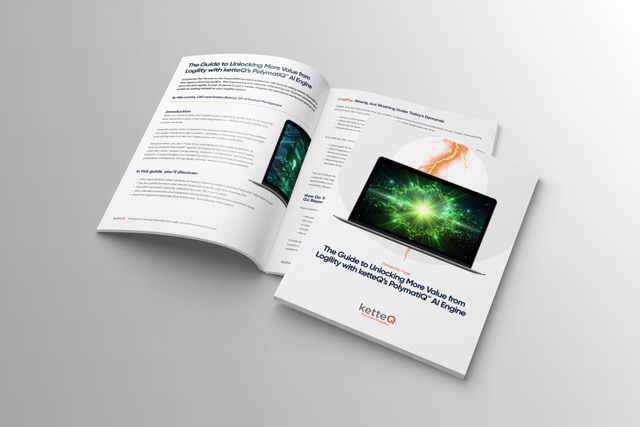
Discover more in our new guide:
The Guide to Unlocking More Value from Logility with ketteQ’s PolymatiQ™ AI Engine.
A propos de l'auteur
Articles connexes

ketteCrew Spotlight: Embracing the Next Era of Planning with Ken Wardlaw
ketteCrew Spotlight: Embracing the Next Era of Planning with Ken Wardlaw